


Does WhatsApp chat increase sales? Yes — and the effect is measurable. Across independent studies, adding a chat channel lifts website conversions by roughly 20% on average (Invesp), and visitors who chat are 2.8x more likely to buy than visitors who don’t (Forrester). But the honest answer comes with conditions: you have to reply fast, your audience has to actually use WhatsApp, and the results vary a lot by industry and traffic quality.
We build a WhatsApp chat plugin, so of course we’d say chat works. That’s exactly why we’ve limited this post to numbers you can check yourself. Every statistic below is attributed to a named source, and there’s a whole section on where the data gets shaky — because some of the numbers floating around this industry deserve skepticism.
Table of Contents
Key Takeaways
- Adding chat to a website lifts conversions by about 20% on average (Invesp), and visitors who chat are 2.8x more likely to convert (Forrester).
- WhatsApp beats email for follow-up: reported open rates near 98% vs roughly 20% for email, and abandoned-cart recovery of 15–30% vs 2–5%.
- Speed is the multiplier. Businesses that respond to a lead within an hour are about 7x more likely to qualify it than those that wait longer (Harvard Business Review).
- 66% of consumers say they’ve made a purchase after chatting with a business on WhatsApp (Meta-commissioned research).
- Vendor claims of “45–60% conversion rates” measure chat-to-sale, not sitewide conversion. A realistic expectation is a 10–30% sitewide lift — if you answer quickly.
- You can verify all of this on your own site in 30 days with GA4 click events and a chat-only coupon code. We show you how below.
What Does the Data Say About Chat and Sales?
Every credible study points the same direction: sites with a working chat channel convert better than sites without one. Invesp’s research aggregation found that adding live chat typically produces a 20% increase in conversions (Invesp). Forrester found that visitors who use chat are 2.8x more likely to convert than those who don’t (Forrester).
It’s not just whether people buy. It’s how much. ICMI benchmark research found that customers who chat spend around 60% more per order than those who don’t. And the effect starts before the sale: an eMarketer survey (widely cited by Crazy Egg and others) found 63% of consumers were more likely to return to — and buy from — a website that offers chat. In Kayako’s survey of over 1,000 US consumers, 38% said they were more likely to buy from a company after a good chat session (Kayako).
Then there’s speed, which turns out to be the biggest lever of all. In 2011, Harvard Business Review audited 2,241 companies and found that firms responding to a lead within one hour were nearly 7x more likely to qualify that lead than firms that waited even an hour longer (Harvard Business Review). A chat button is, at its core, a speed machine: it collapses the gap between “I have a question” and “I got an answer.”
Notice a pattern, though? None of those numbers are about WhatsApp specifically. They’re about chat as a channel. So what changes when the chat runs on WhatsApp?
How Does WhatsApp Compare to Email and Phone?
The short version: WhatsApp messages get read, email mostly doesn’t, and phone calls increasingly go unanswered. Industry benchmarks put WhatsApp open rates near 98%, against roughly 20% for email. For abandoned carts, WhatsApp recovery campaigns report 15–30% recovery versus 2–5% for email sequences (Chatarmin measured 18–23% across its own client data).
Consumer behavior backs this up. In a Meta and Boston Consulting Group survey of more than 6,500 consumers, 64% said they’d rather message a business than call it (Meta/BCG). In Meta-commissioned research on business messaging, 66% of consumers said they had purchased after chatting with a business on WhatsApp (Meta, State of Business Messaging). And Meta/BCG’s 2026 conversational commerce research reports cart-to-purchase rates around 41% higher when customer questions get answered in real time during checkout.
| Channel | Open / answer rate | Typical response time | Conversion signal |
|---|---|---|---|
| WhatsApp chat | ~98% reported open rate (read receipts make this measurable) | Seconds to minutes | 15–30% cart recovery; 66% of consumers have bought after a WhatsApp chat |
| ~20% open rate; 2–5% click-through | Hours to days | 2–5% cart recovery; declining reach due to spam filtering and tab sorting | |
| Phone | Low and falling — most people won’t answer unknown numbers | Immediate if answered; often never | High intent when connected, but no written record and no async follow-up |
One more number matters if your visitors are in South Asia, Latin America, MENA, or much of Europe — markets where WhatsApp is the default messenger. Tidio’s research found 73.6% of chat conversations now happen on mobile, and mobile visitors who chat are 6.1x more likely to convert than mobile visitors who don’t (Tidio). A WhatsApp button meets those customers inside an app they already check dozens of times a day.
Where the Data Gets Murky
Not every number in this industry deserves your trust, including some that get repeated everywhere. Before you build a business case, here’s what to discount.
The “45–60% conversion rate” claims. Some chat vendors advertise conversion rates of 45% or even 60%. Read the fine print: they’re measuring chat-to-sale — the share of people who already started a conversation and then bought. Those people were your hottest visitors to begin with. If your site converts at 2% today, no widget will take it to 45%. The honest metric is sitewide lift, and the credible range for that is 10–30%.
Correlation isn’t causation. Chat users convert 2.8x more often partly because people who bother to ask a question were already close to buying. The chat didn’t create all of that intent — it captured it. That’s still valuable (a captured sale beats a bounced one), but it means you shouldn’t multiply your whole funnel by 2.8 in a spreadsheet.
The 98% open rate has no traceable primary study. It’s cited in hundreds of articles, but nobody links to original research. The best measured benchmark we’ve found puts opt-in WhatsApp read rates around 68% — lower than the headline number, yet still more than three times email’s open rate. The direction of the claim is right; the precision is marketing.
Some of the classic studies are old. The Invesp, Forrester, and Kayako figures originate from the mid-2010s. Newer data (Tidio, Meta/BCG) points the same way, which is reassuring — but treat every specific percentage as directional, not gospel. Your site is the only dataset that actually matters, and we’ll show you how to read it in a minute.
Why Does WhatsApp Beat a Generic Live Chat Widget?
Traditional live chat and WhatsApp chat look similar on the page — a floating bubble in the corner. The economics underneath are different, and four differences do most of the work.
- The conversation survives the visit. A live chat session dies when the visitor closes the tab. A WhatsApp thread lives in their pocket. You can answer twenty minutes later and still make the sale — and they can find you again next week without remembering your URL.
- No account, no app, no friction. More than two billion people already have WhatsApp installed. There’s nothing to sign up for, no “enter your email to start chatting” gate that quietly kills conversations before they begin.
- It’s mobile-native. With 73.6% of chats happening on mobile (Tidio), the channel that works best is the one designed for a phone. WhatsApp is that channel — typed web-widget chats on a phone keyboard are not.
- Notifications actually get seen. Your follow-up email lands in a Promotions tab. Your WhatsApp reply lands on a lock screen. That difference is most of why cart-recovery numbers diverge so sharply between the two channels.
To be fair, dedicated live chat still wins in some setups: large support teams that need ticket routing, or audiences that prefer staying anonymous. But for a small business or store where the owner or a small team answers the messages, WhatsApp’s persistence and reach are hard to argue with.
How Do You Measure It on Your Own Site?
Don’t take our word for any of this — or any vendor’s. The whole experiment costs nothing and takes about 30 days. Here’s the setup we recommend.
- Track button clicks as GA4 events. Fire an event (e.g.,
whatsapp_click) whenever someone taps the chat button. ChatHelp includes a built-in analytics dashboard that tracks views, clicks, and device breakdown; alternatively, a Google Tag Manager click trigger on the button’s link does the same job. - Use a chat-only coupon code. Create a discount code you share only inside WhatsApp conversations. Every redemption is a sale you can attribute directly to chat — no analytics ambiguity, no modeling.
- Compare chat vs non-chat conversion rates. In GA4, build a segment of sessions containing your
whatsapp_clickevent and compare its purchase rate to everyone else’s. Run it for 30 days or until you have a few hundred chat clicks, whichever comes second.
A quick sanity check on expectations: say you get 10,000 visits a month at a 2% conversion rate — 200 orders. If 3% of visitors start a chat and those 300 people convert at even 5% (well below the 2.8x multiplier), that’s ~15 extra orders, a 7–8% lift, before counting the 60% higher order values or recovered carts. Modest per month. Meaningful per year. And if your numbers come back flat? Remove the button. That’s the whole risk.
How to Add WhatsApp Chat to WordPress in 5 Minutes
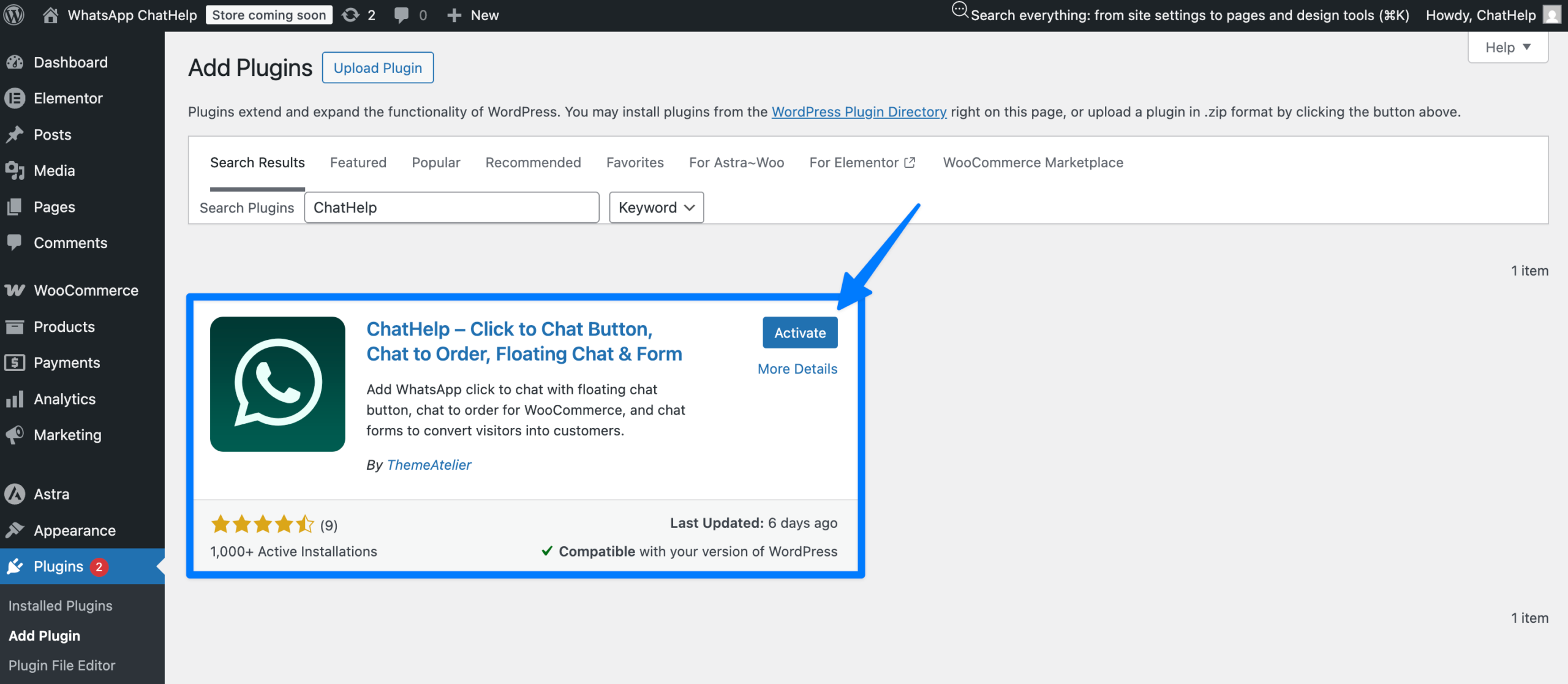
You don’t need code or a developer for this. ChatHelp is our free WhatsApp chat plugin for WordPress, and the whole setup looks like this:
- In your WordPress dashboard, go to Plugins → Add New, search for “ChatHelp”, then install and activate it.
- Open the WhatsApp Chat menu and add your WhatsApp or WhatsApp Business number.
- Pick a layout — floating button, pre-chat message box, or a chat form that captures leads even when you’re offline.
- Set a pre-filled message. Dynamic variables can insert the page URL or WooCommerce product name automatically, so a customer’s opening message arrives as “Hi, I have a question about [Product X]” instead of just “Hi”.
- Publish, tap the button on your phone to test it, and watch the built-in analytics.
The free version covers everything needed to run the 30-day experiment above, including WooCommerce buttons on product, cart, and checkout pages, GDPR consent, and the analytics dashboard. If the experiment pays off, ChatHelp Pro adds multi-agent layouts, advanced page and product targeting, and webhook integrations — useful once chat starts producing enough sales to justify a team around it.
Frequently Asked Questions
Does WhatsApp chat really increase sales?
Yes, when replies are fast. Adding chat lifts conversions ~20% on average (Invesp), chat users are 2.8x more likely to buy (Forrester), and 66% of consumers report purchasing after a WhatsApp conversation with a business (Meta). Slow replies erase most of the benefit — speed is the condition.
What is a good WhatsApp conversion rate?
For chat-to-sale — conversations that end in a purchase — 15–30% is strong. For sitewide impact, expect a 10–30% conversion lift. Treat vendor claims of 45–60% skeptically: those measure only visitors who already chatted, who were your highest-intent traffic to begin with.
Is WhatsApp chat better than live chat?
For small businesses and mobile-first audiences, usually yes. WhatsApp conversations persist after the visitor leaves your site, require no account, and its notifications get seen — 64% of consumers prefer messaging a business to calling it (Meta/BCG). Large support teams needing ticket routing may still prefer dedicated live chat.
How do I add WhatsApp chat to WordPress?
Install a free plugin like ChatHelp from the WordPress plugin directory, add your WhatsApp number, choose a button layout, and set a pre-filled message. Setup takes about five minutes and requires no code. WooCommerce product and checkout page buttons are included in the free version.
Does WhatsApp chat work for non-ecommerce sites?
Yes — arguably better. For service businesses, the sale is the inquiry, and speed decides who wins it: responding to a lead within an hour makes you ~7x more likely to qualify it (Harvard Business Review). A WhatsApp button turns a form-fill that waits overnight into a conversation that starts now.
The Bottom Line
Does WhatsApp chat increase sales? The data says yes — a realistic 10–30% conversion lift, higher order values, and cart recovery email can’t match — with two conditions attached. Your customers need to be WhatsApp users (in most of the world, they are), and you need to answer quickly, because response speed is where the 7x multiplier lives.
The good news is you don’t have to trust our numbers or anyone else’s. Install the free ChatHelp plugin, set up the GA4 event and a chat-only coupon, and let 30 days of your own data settle the question.
Sources
- Invesp, “The Importance of Live Chat Customer Support – Statistics and Trends,” retrieved 2026-07-10, invespcro.com/blog/live-chat-customer-support
- Forrester, “Retailers Without Chat: A Missed Opportunity,” retrieved 2026-07-10, forrester.com/blogs/retailers-without-chat-a-missed-opportunity
- Harvard Business Review, “The Short Life of Online Sales Leads,” retrieved 2026-07-10, hbr.org/2011/03/the-short-life-of-online-sales-leads
- Kayako, “Live Chat Statistics” (survey of 1,000+ US consumers), retrieved 2026-07-10, kayako.com/live-chat-software/live-chat-statistics
- Meta & Boston Consulting Group, “Business Messaging: The Quiet Channel Revolution” (survey of 6,500+ consumers), retrieved 2026-07-10, facebook.com/business/news/business-messaging-report-APAC-BCG-Meta
- Meta / WhatsApp Business, “The State of Business Messaging,” retrieved 2026-07-10, business.whatsapp.com/resources/resource-library/state-of-business-messaging
- Tidio, “Live Chat Statistics,” retrieved 2026-07-10, tidio.com/blog/live-chat-statistics
- Chatarmin, “Abandoned Cart Recovery via WhatsApp: 18–23%,” retrieved 2026-07-10, chatarmin.com/en/blog/how-to-recover-abandoned-carts-via-whatsapp
- SuperOffice / eMarketer, “Live Chat Statistics” (63% return-visit figure), retrieved 2026-07-10, superoffice.com/blog/live-chat-statistics